Edition Notes
For Immediate Release
October 15th, 2026. Paris.
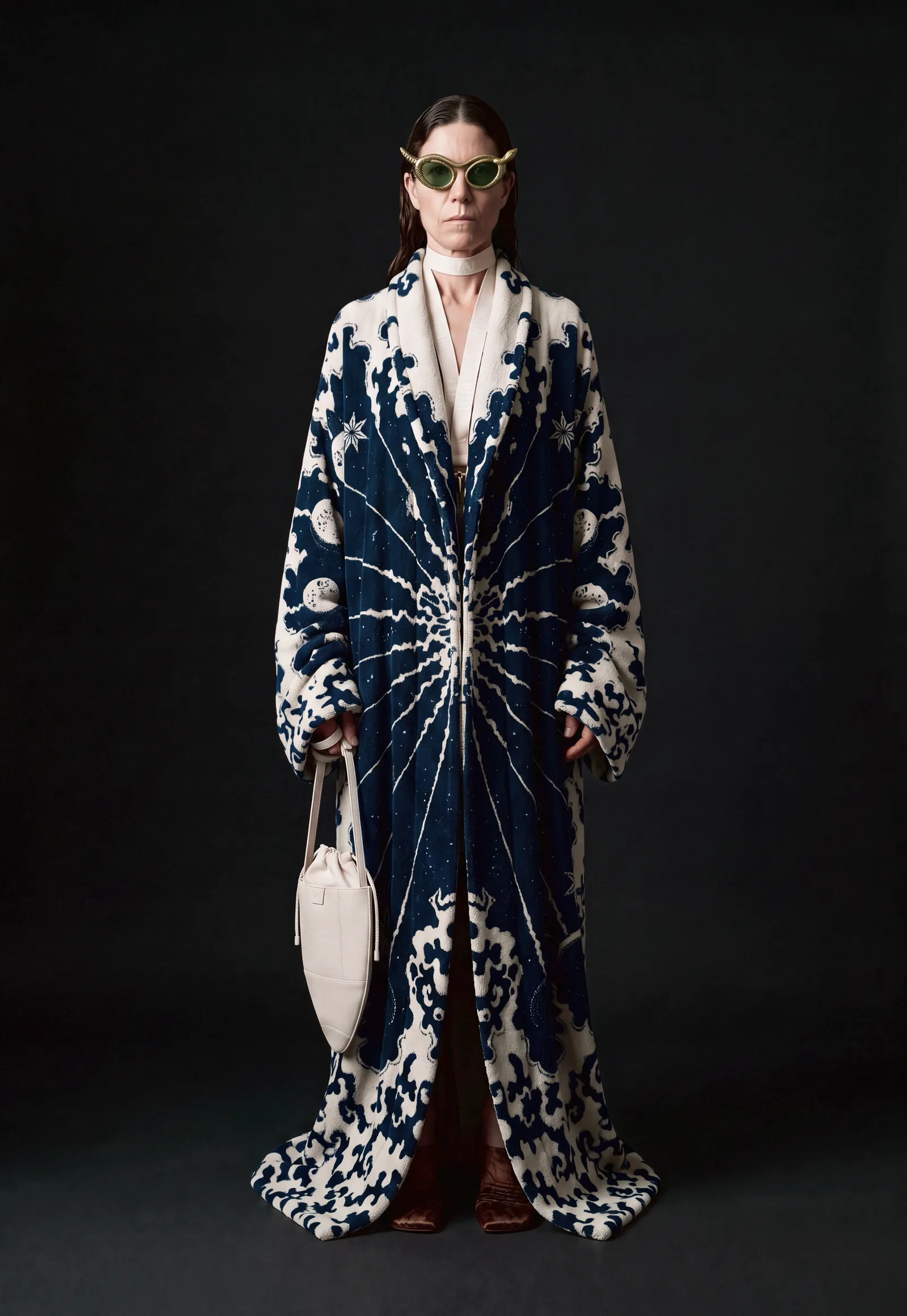
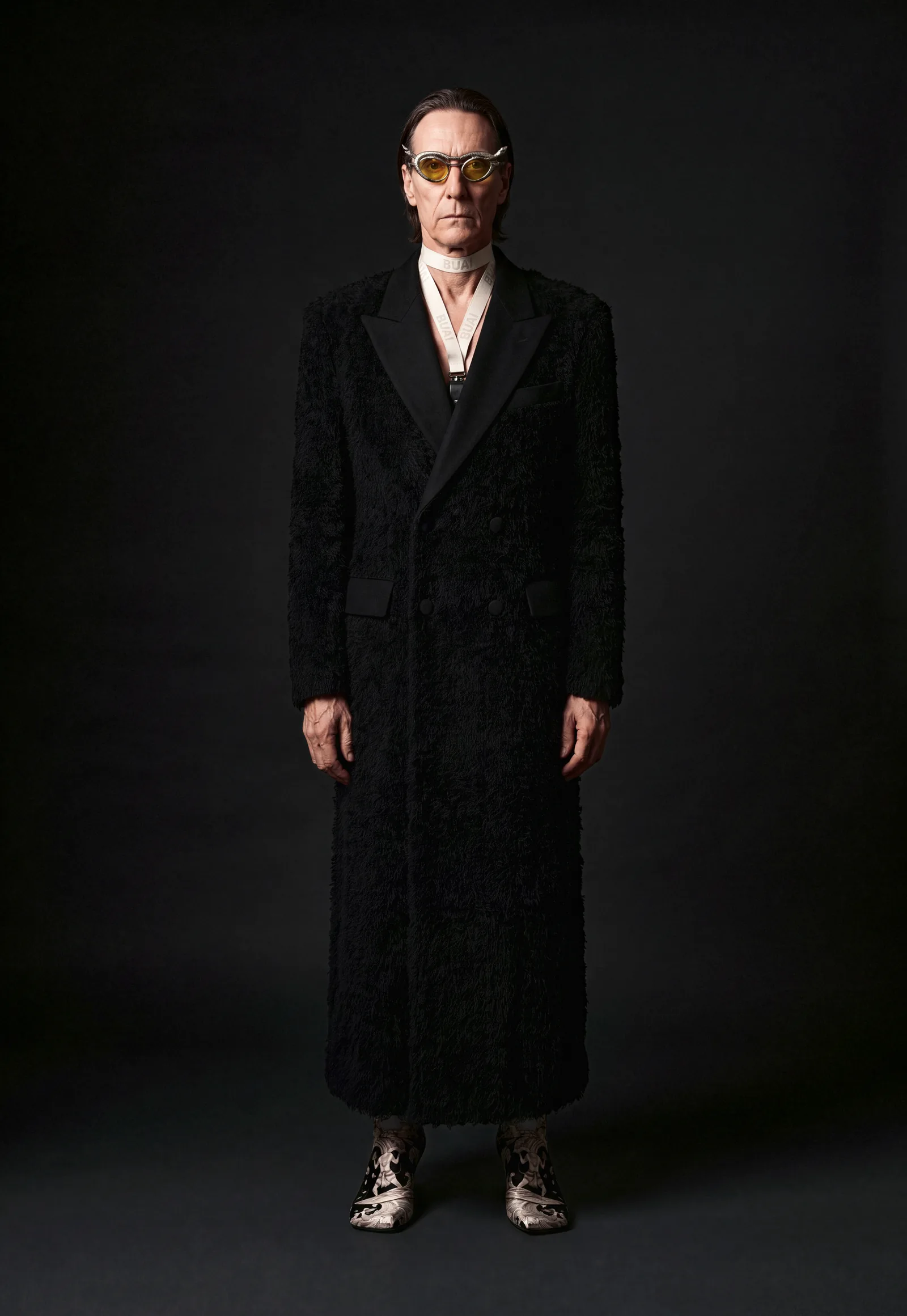
FIG. 027
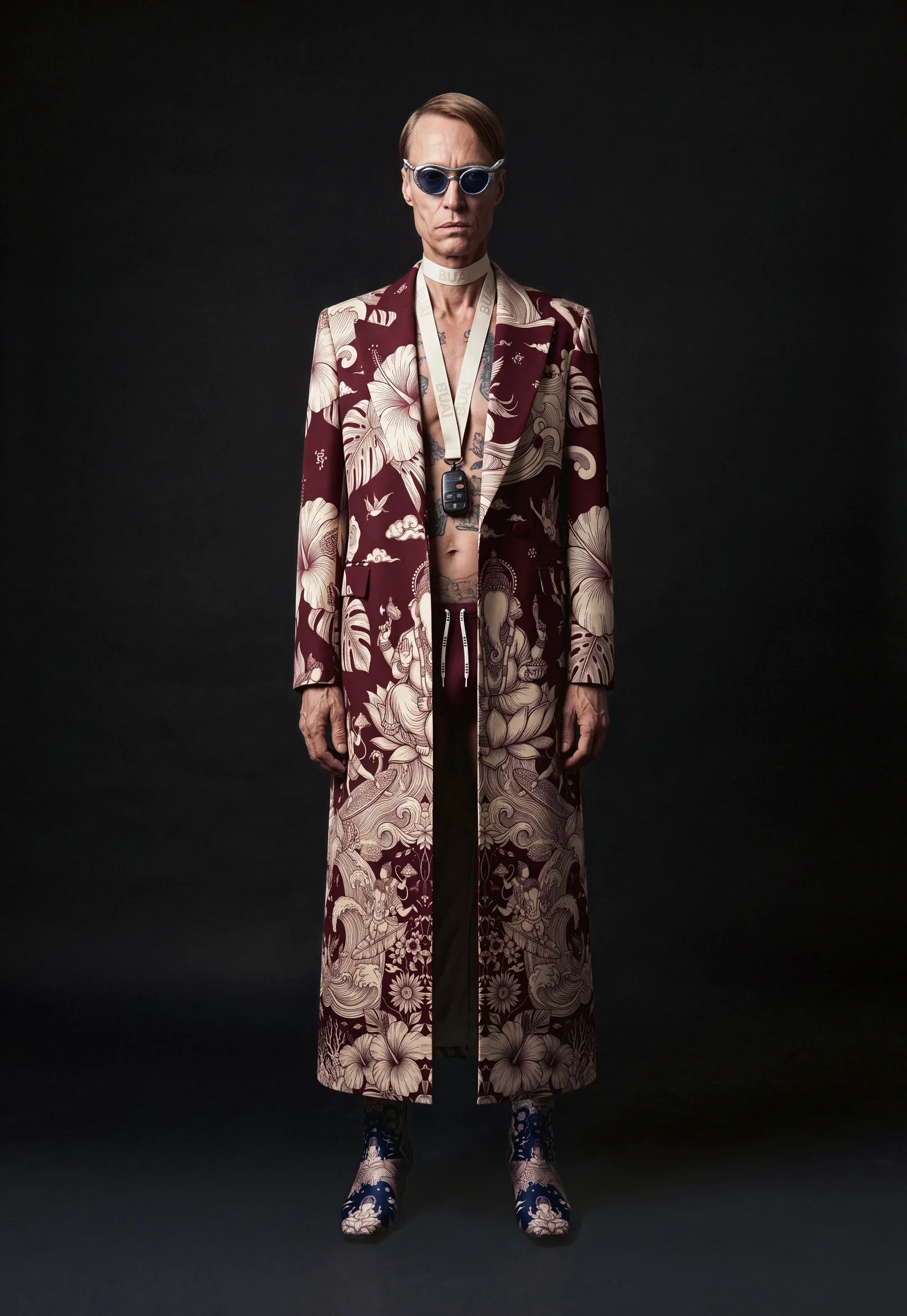
FIG. 015
EDITION 001.A: Summer After the Fire
Spring/Summer 2027.
BUAI, the project of designer and creative director Lukas Vincent, presents its first edition, Summer After the Fire. Each garment is catalogued as an artifact within a larger cultural system.
Menswear and womenswear. Thirty looks in five parts. The first entry in an archive of observations.
BUAI carries four inheritances, none of them chosen. The acronym — Born Under Ancient Influence — states the house’s first principle: no one is self-made. Each person arrives into systems older than themselves — language, myth, hierarchy, the readings a culture has made of sky and sea. We do not choose these; we inherit them, then build. Buai is also the Tok Pisin word for betel nut, from the Tolai people of Papua New Guinea — the small object passed hand to hand that opens a social space, offered in welcome and shared at gatherings. Vincent’s father was raised there and carried the word out with him: a family inheritance, not a chosen reference. In Malay and Indonesian, buai means to swing, and to cradle — the first structure a person is held inside. Together, the name redirects “influence” from its current sense — visibility, reach, the crowd instructing itself — back to an older one: influence as origin, treated not as popularity but as transmission.
The method has three steps. Observation. Adoption. Identity. The work is made from the position of the participant-observer — close enough to a culture to absorb its ritual, separate enough to read the system that produces it. Identity is constructed. The garment is one of the tools. Edition 001.A spans menswear and womenswear as a single wardrobe: the premise does not change by gender.
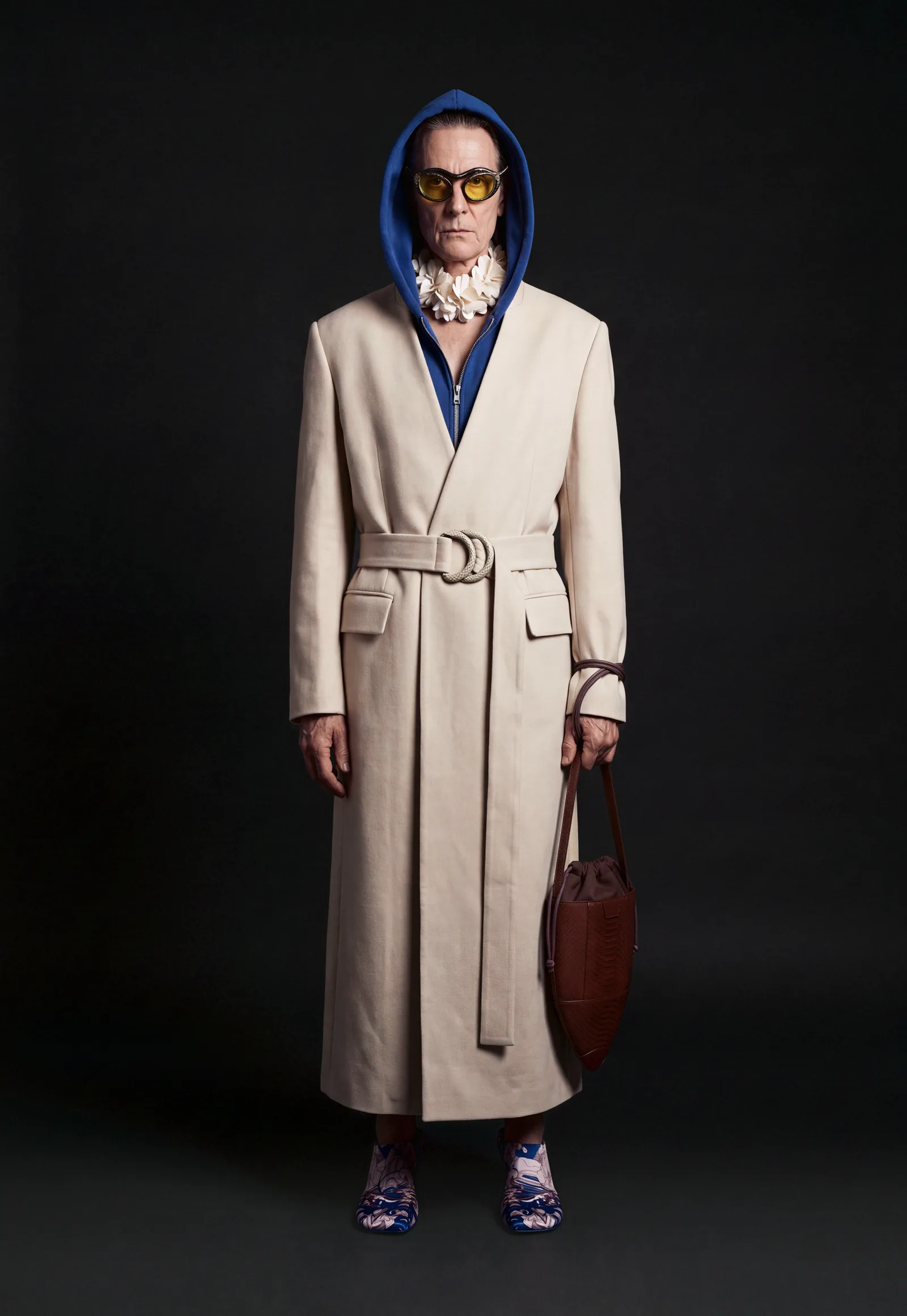
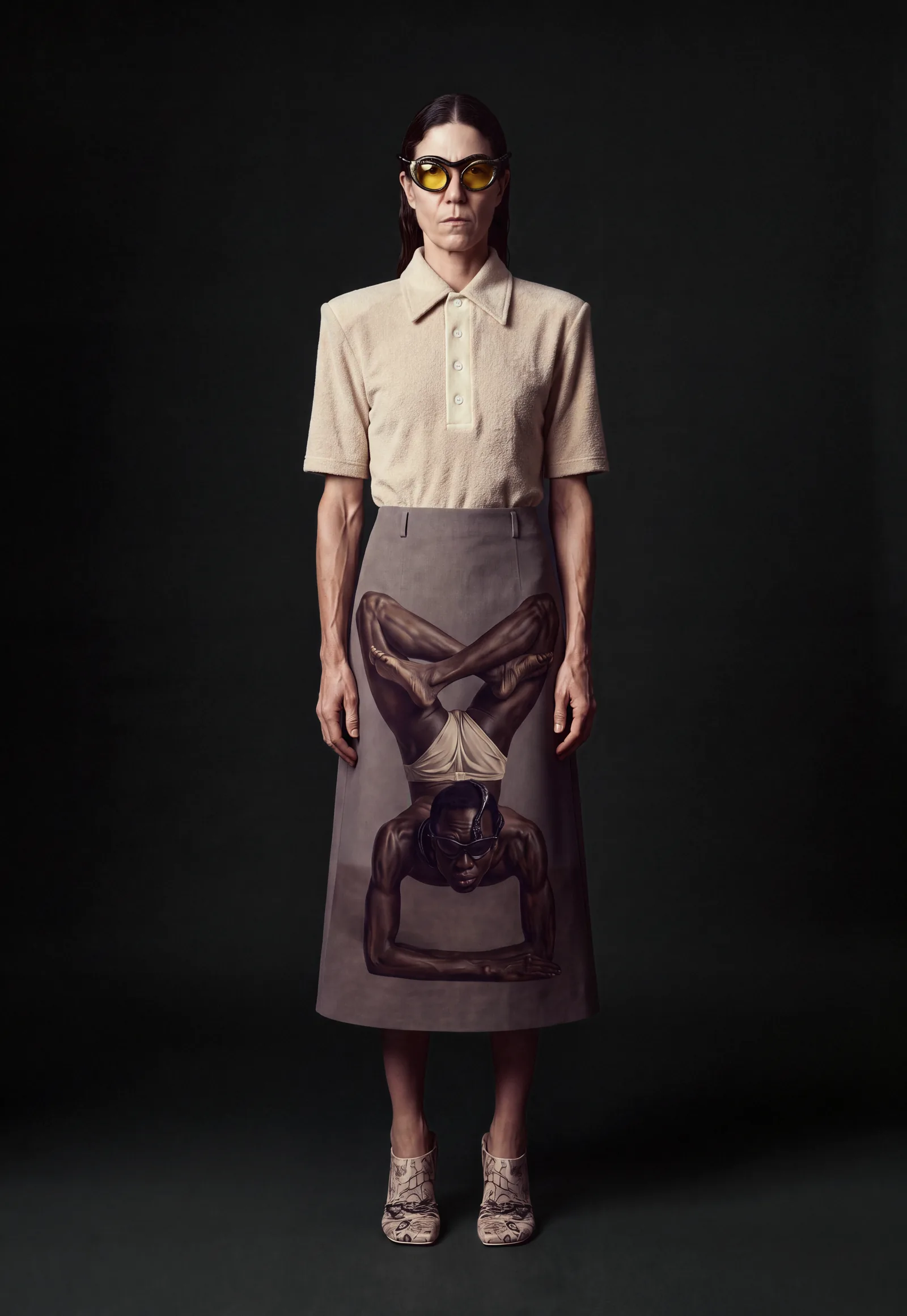
Summer After the Fire reads in three registers at once: literal, cross-cultural, biographical. Fire marks a threshold — what is burned away, and what is built from what remains. Some seed only opens at a fixed temperature. The edition assumes the same condition: a point that has to be crossed before anything forms. What follows is not recovery. It is the first thing to grow once the temperature was reached.
“Between ex infinitas and BUAI there was no plan, only observation. I’ve lived inside many worlds and belong fully to none — that displacement isn’t a wound, it’s the instrument. BUAI is the record of what stayed with me.”
— Lukas Vincent
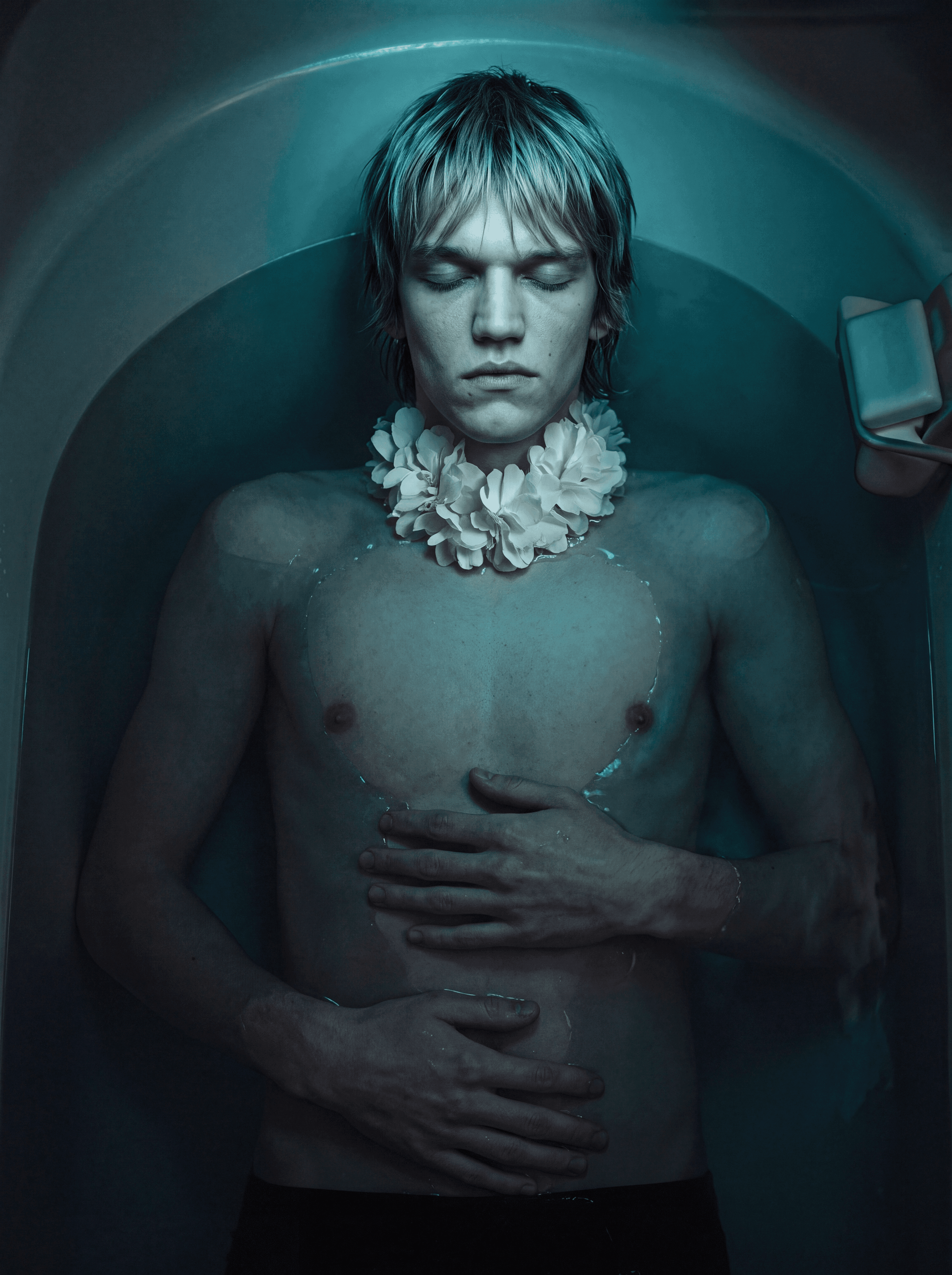
The edition unfolds across five parts: Seeing Things (Observation as Foundation), Constructed Forms (Identity Through Color), On Devas, Gods & Creators (Influence as Origin), The Offering (Ritual Documentation), and A Guided Tour of Nirvana (Emptiness and Liberation). Read in sequence, they trace a single passage. Observation comes before belief. Identity is assembled through colour. An invented mythology reaches full strength in Surf Gods, a devotional toile made for a culture that has ritual but no iconography of its own, its deities rendered mid-wave. At the offering, the constructed self is set down among its possessions. The crossing is cut in black, and one artifact carries the sky through it: the Cosmological robe-coat, a radiating field of suns, moons and stars. The fire sits fourth in the sequence, not first. Everything before it is what burns; everything after it is what remains.
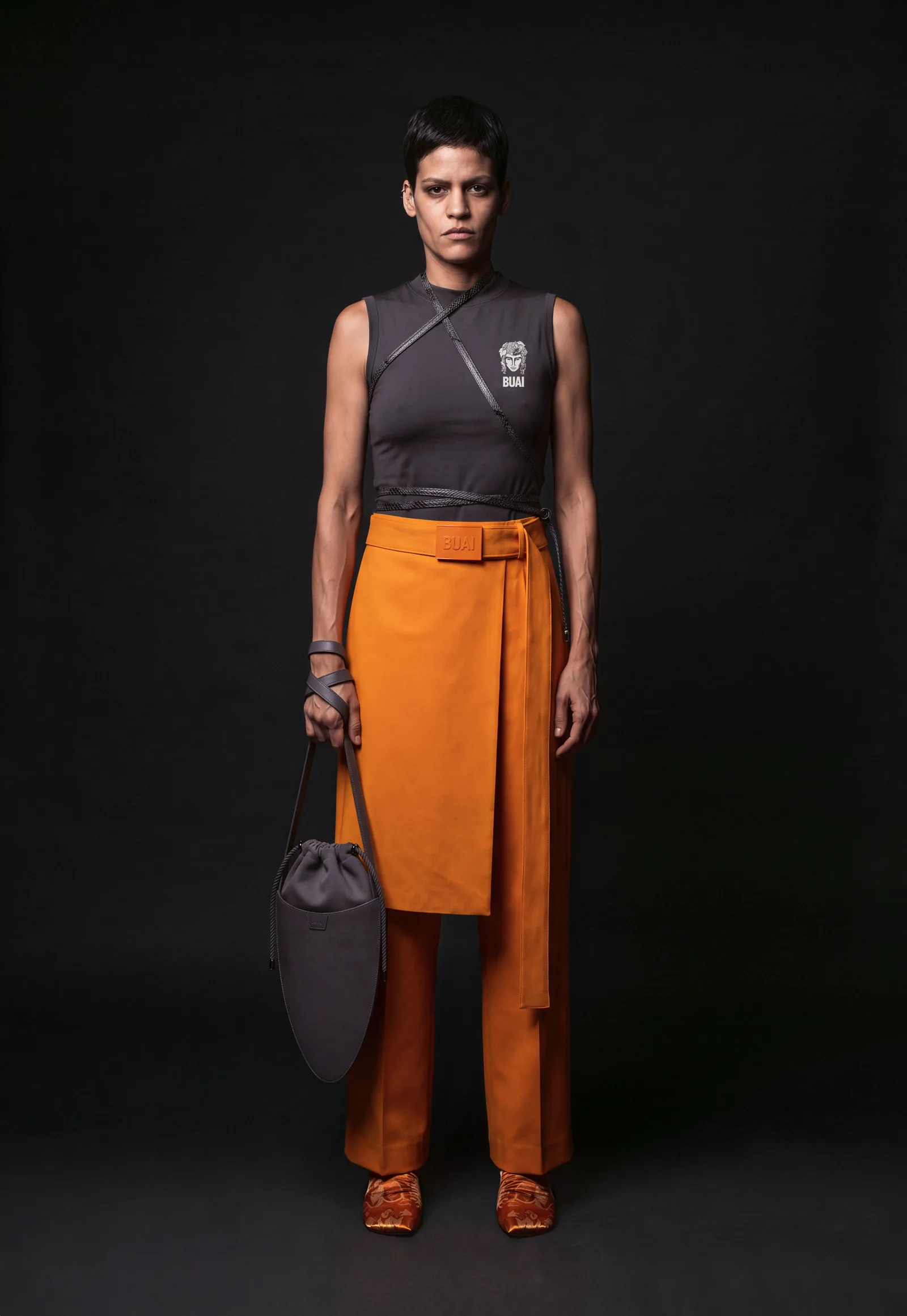
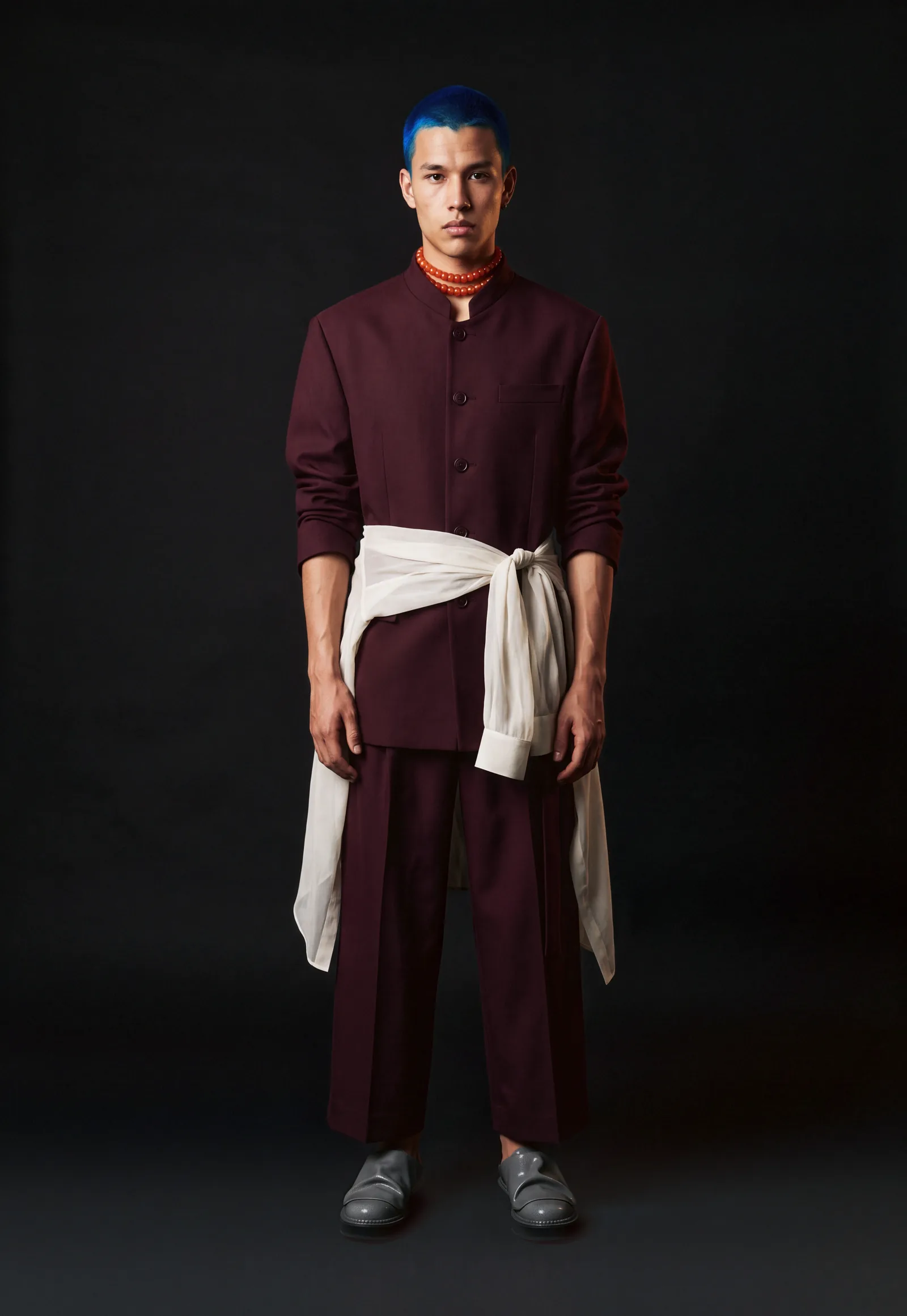
Each look is built on deliberate opposition: tailoring against exposed skin, swim and underwear treated as foundation garments rather than what is covered, the tuxedo cut in towelling, workwear remade in knitted metal. The friction runs within single garments and across the sequence alike, and it is never resolved. Identity is assembled out of materials that do not naturally agree, and the wardrobe admits it.

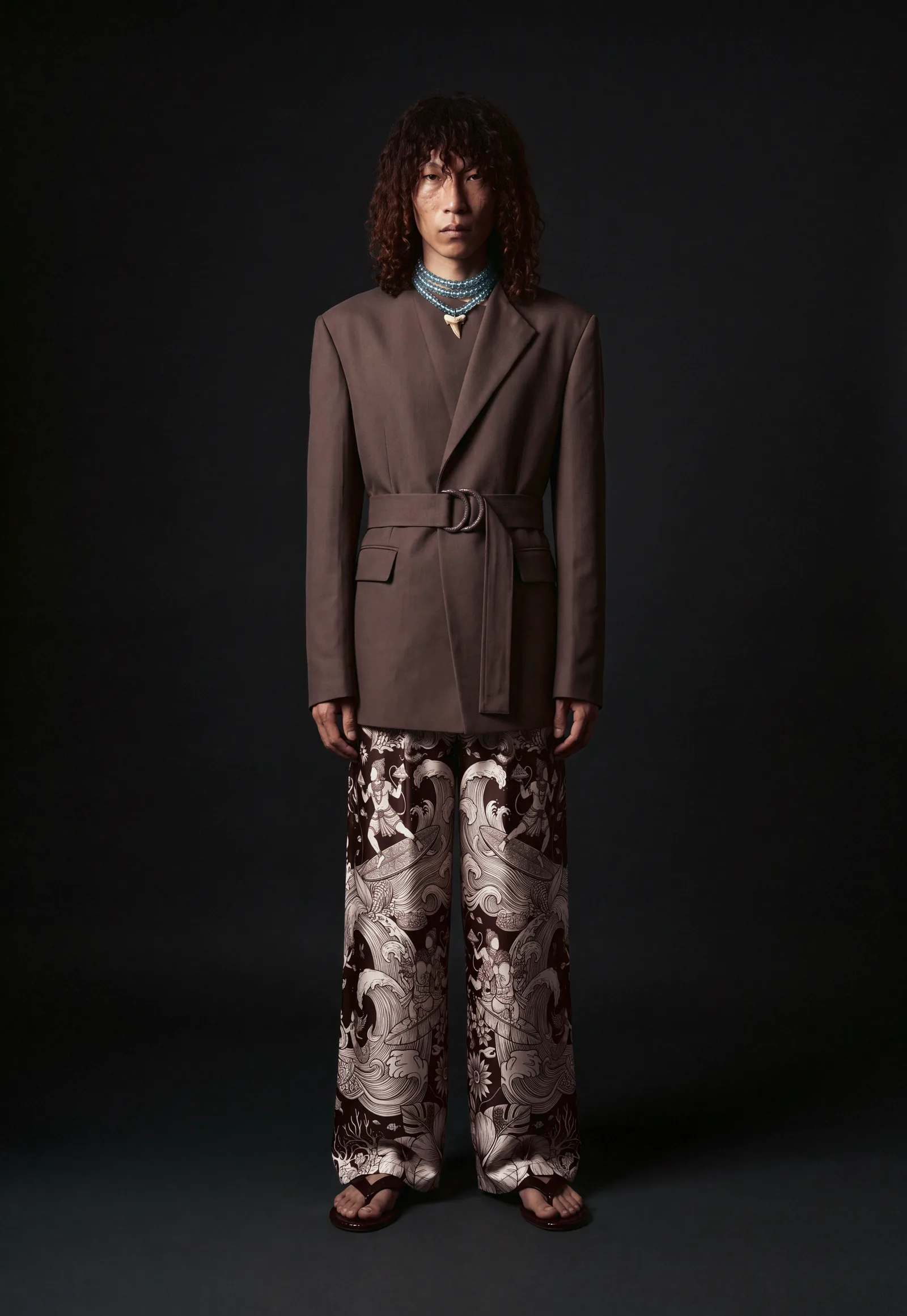
The palette holds to nine named colours: Volcanic Black, Bister, Vellum, Bone White, Tibetan Red, Mazarine Blue, Aquarius Blue, Saffron and Natural. Silhouettes stay simple. The cloth carries the information.
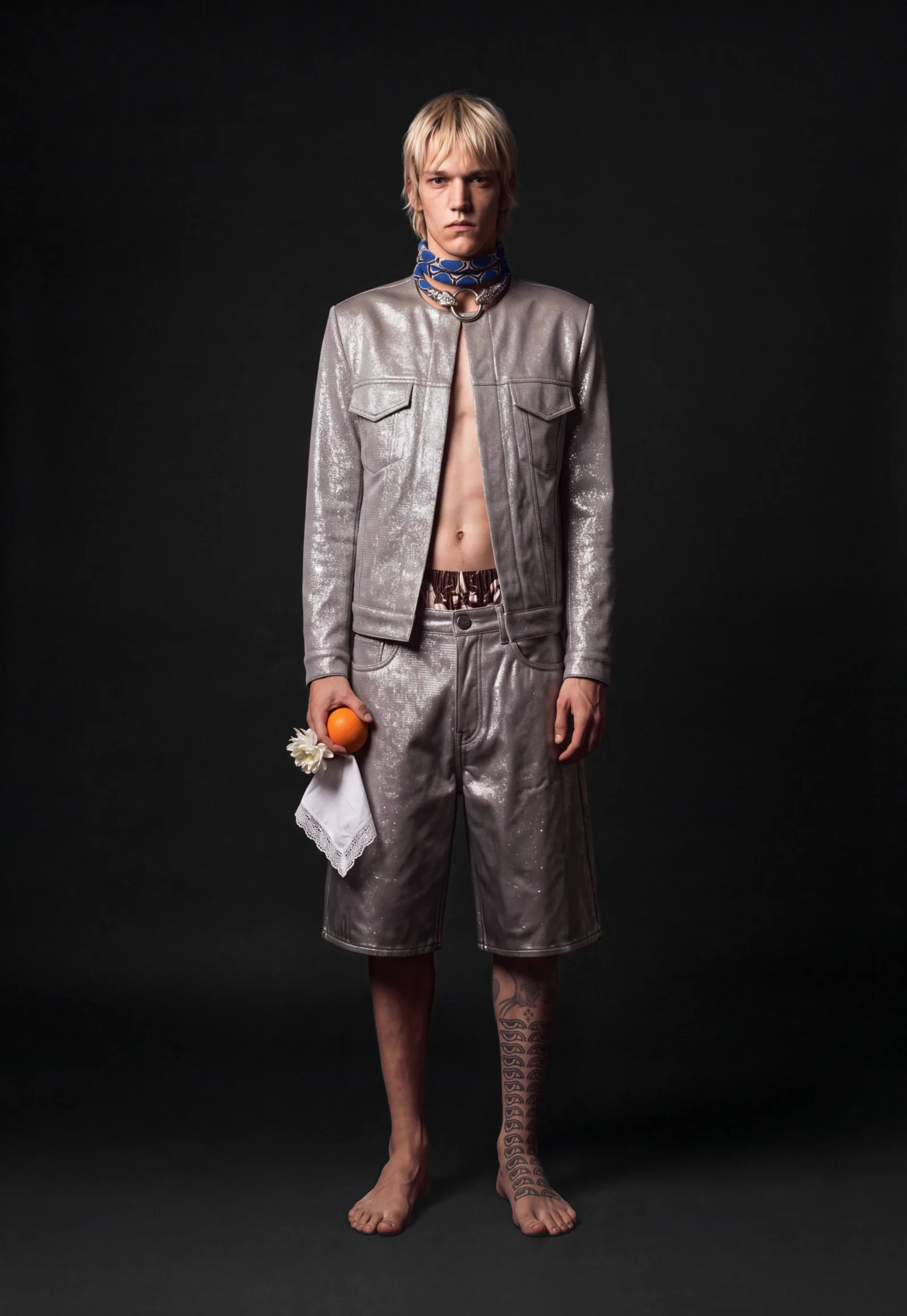
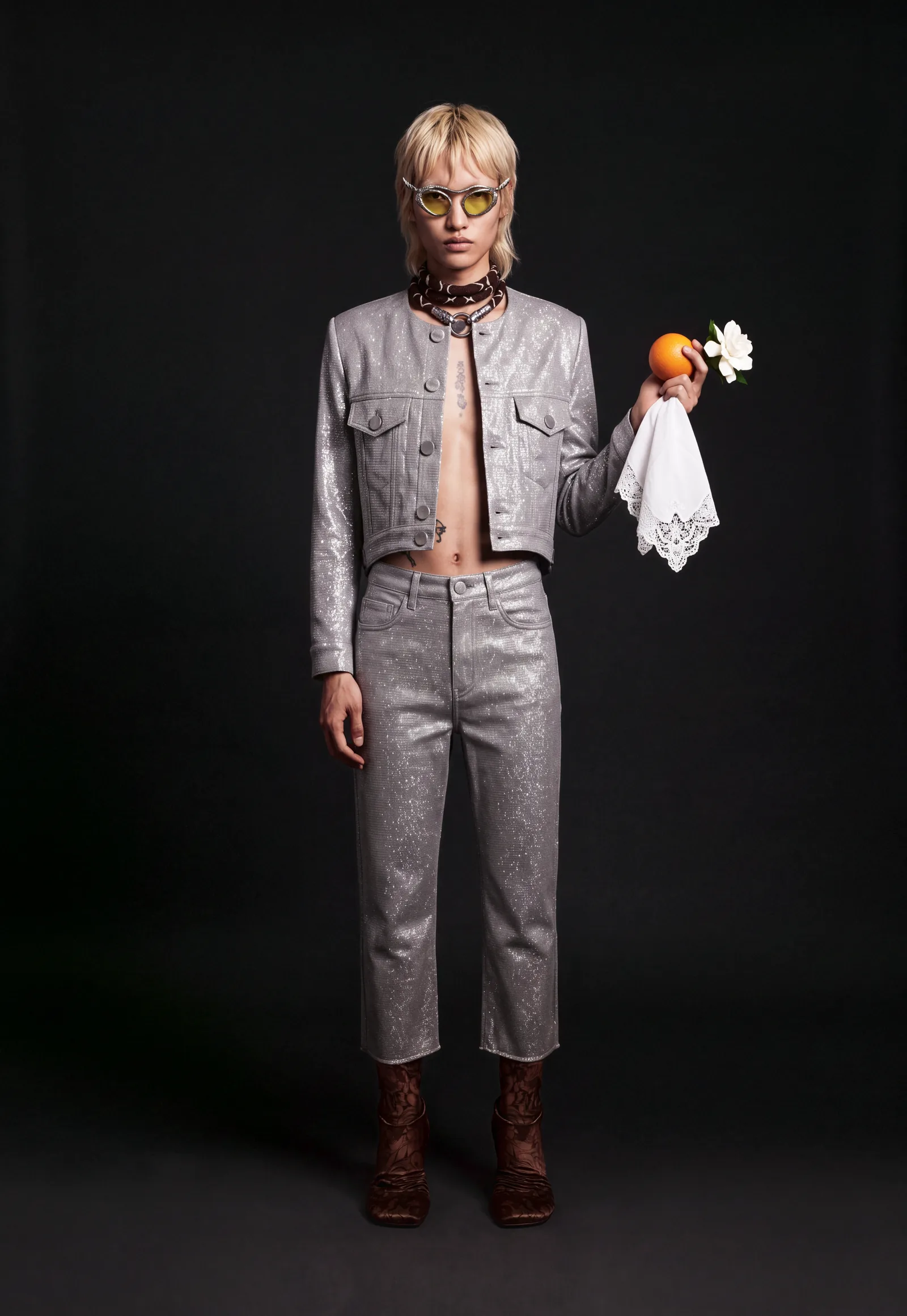
Tailoring is cut from 100% wool Panama and a wool canvas topped with viscose for a satin surface. The Surf Gods artwork is carried on 100% silk twill and, at a more accessible price point, on a viscose twill, both printed in Tibetan Red, Mazarine Blue, Saffron and Volcanic Black. A recycled cloth is hand-woven by Indonesian master artisans practising the traditional art of Bedeg, from strips cut from hand-picked vintage T-shirts. The fragments of colour across the chest and back are the original prints of those T-shirts, each strip placed individually by hand. The cloth is then fully tailored into coats and shirts. The knitted metal jersey Lancelot is custom-laminated with Japanese denim. Swim uses regenerated Econyl®.
The lookbook is constructed rather than photographed. Each look is generated from 2D technical sketches worked in conjunction with the actual sampled cloth, rendered ahead of the production run. No shoot took place. BUAI treats the image as another artifact in the system — a record of intent.